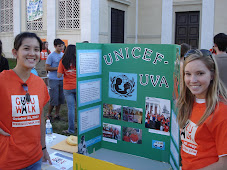
Sunday, June 15, 2008

www.giveadrop.com for cleaner, safer drinking water!

Hey UNICEF-UVAers! I hope you all are having a fantastic summer. As I was sitting here at 1 am studying for my LSAT, I was surfing Perezhilton.com and found a great link that is incredibly relevant to our theme of world hunger/clean drinking water for next year, so I thought I'd give you all a heads up to learn more or donate.

www.giveadrop.com

Project Clean Water is being run by Virgin and the singer Jewel to provide clean drinking water for people around the world who are in desperate need of a safe water source. They're involved in education, sanitation of water supplies, and research in sustainability.

Here are some statistics from their page:
"...some 40 billion working hours are lose each year in Agrica to time spent carrying water."
"443 million school days are lost each year due to water-related diseases"
"$15 can purchase a small scale water filter for a family"
"$2500 can provide an entire village with a fully equipped water well"

Check the site out!

Tuesday, April 22, 2008

Apr 21 Meeting-Last of the Year!

Hey UNICEF-UVA members!

Here are the notes from Monday's meeting if you missed it.

Announcements:
-T-shirts for next year! The design is all set, the t-shirts will be between $10-12
-Dues for next semester will be $5

Goals:
-increase membership
-increase club unity
-plan events early and efficiently

Gulu Walk
-Music: a band from CNU expressed interest to come
-Speakers--authors of "Three Cups of Tea"--Greg Mortenson and David Relin
-Food--later date--last year we had TONS of donations
-Location--amphitheater, rain site Mem Gym
-Time: afternoon or evening--2-7 ish (not the whole time, 2-5 or 4-7)

Theme:
-we decided not to focus on one country, but more on a theme that affects several, if not all, countries to some degree: WORLD HUNGER AND CLEAN WATER
-incorporating issues in Latin America, Asia, and Africa

5k
-theme will be poverty, clean water, or both in accordance with our overall group theme for the year
-Selam and Kelsey (Me!) will be planning the run and contacting Ragged Mountain for help
-this is for SPRING semester, since we have the Gulu Walk in the fall

Membership
-computer sign up for Activities Fair
-promotional movie with photos from last year
-wearing GULUWalk shirts since ours won't be ready
-blue and white balloons

Recommendations for Next Year
-planning events early
-relying less on cosponsorship--plan event and then look for friendly groups
-attendance at meetings
-ICE CREAM SOCIAL/COOKOUT for first meeting
-utilize facebook group better

Alrighty guys! We got a lot done, and we're all excited to get some good stuff done together next year! I hope you all do well on finals and enjoy your summer!

Monday, April 14, 2008

Meeting--ELECCIONES!

Hola amigos!

Today at our UNICEF-UVA general body meeting, we held elections for our major positions. With tight races all around, we welcome our upcoming executive body:

Madame President - Ashi (cue "Hail to the Chief")
Vice-President - Kim
Secretary - Rachel
Treasurer - Biruh
Publicity - Saana
Publicity Committee - Megan, Tiffany, Bianka, Whitney
Outreach - Rashmita
Events Coordinator - Selam
Historian - Kelsey
Webmaster -Mehak

I, as historian, will be your faithful blogger, along with fellow dedicated gal Samantha, who will be joining me on this site.

Together, we will be blogging about recent news events, upcoming related social events here on campus and nearby locales, and fun factual information in order for our readers to become more aware of what is going on in the world as it relates to UNICEF.

Thanks for reading, and I look forward to blogging for you!

Saturday, April 12, 2008

U.N. Teams With Google Earth To Track Refugees, Educate Public


Washington Post Staff Writer
Saturday, April 12, 2008; Page D02

Can Google Earth save the world?

The U.N. High Commissioner for Refugees announced a new partnership with the search engine this week. The goal: To use Google's globe-mapping software to illustrate the plight of parts of the planet's population.

Google Earth, a free, virtual-globe program from the search engine company, lets users zoom in on locations around the planet. Users can also use special programs known as layers, which organizations can build to incorporate video, text or other interactive features.

Under an outreach program, Google has been populating its virtual globe with socially minded projects from such organizations as Greenpeace, the U.S. Holocaust Memorial Museum and UNICEF. Six such layers have been launched in the past two weeks.

Click on the United Nations' "visit a camp" button in Google Earth, for example, and an online depiction of the globe spins and zeroes in on a satellite view of a refugee camp in Chad. There, visitors learn about the refugees who have fled to that country from western Sudan's Darfur region. Click on a button and users can find out how much money it costs to install, say, a new water source at the camp. Click again and users can donate that amount.

"The great thing about Google Earth is it gives you that ability to be there," said Tim Irwin, a spokesman for the U.N. refugee organization. "We're hoping to take something that might be a little abstract for some people and make it very real."

Rebecca Moore, manager of Google Earth Outreach, said she is hoping the software can be used by organizations on a larger scale. "This sort of immersive experience can lead to greater understanding, greater compassion and a desire to help," she said.

The U.S. Holocaust Memorial Museum launched "World is Witness," a layer that traces a recent trip to Rwanda to learn about the 1994 genocide there.

Last year, the museum was the first nonprofit organization to launch a Google Earth layer. The museum credited the program for increasing traffic to its "How can I help" page from 2,500 visitors a month to more than 50,000.

"It has been hugely helpful in terms of our outreach efforts," said John Heffernan, director of the museum's Genocide Prevention Initiative.


http://www.washingtonpost.com/wp-dyn/content/article/2008/04/11/AR2008041103566.html?hpid=topnews

Sunday, February 17, 2008

Wealth 'may not lead to health'

By David Loyn
International development correspondent

File photograph of a Malawian woman and her grandson at an emergency nutrition centre in Malawi
Malnutrition is a major cause of childhood death in parts of Africa
Economic growth does not necessarily translate into improvements in child mortality, major new research suggests.

Ten million children still die every year before their fifth birthday, 99% of them in the developing world, according to Save the Children.

A study comparing economic performance with child mortality reveals that some countries have not translated wealth into improvements across society.

Survival is too often just a "lottery", said Save the Children's David Mepham.

He said that even the poorest countries can cut child mortality by following simple policies, but at the moment "a child's chance of making it to its fifth birthday depends on the country or community it is born into".

Lagging behind

Angola comes at the bottom of a new "Wealth and Survival" league table drawn up by the UN Development Programme (UNDP).


There are few countries in the world where there are such stark wealth contrasts as there are between the wealth of oil-rich coastal strip around the Angolan capital Luanda, and the war-ravaged interior.

UNDP statisticians calculate that more than half of the babies who die in Angola could be saved were the country to spread its wealth more fairly.

Some of the poorest countries in the world - Nepal, Malawi, Tanzania and Bangladesh - are among the top ten performers in this index, showing success in cutting mortality.

But India, the fastest growing economy in South Asia, lags well behind its poorer neighbors.

Some states in India, including Orissa, Rajasthan and Bihar, have child and maternal mortality rates that are among the worst in the world.

Limited bonuses

On a visit to rural Orissa, it was not difficult to see why child survival is a matter of chance.

It can take days for villagers to reach medical help, and travel may involve boats or auto-rickshaws.

Dr Baharudat Mishra said that although the government did give a bonus to doctors to work in the outlying regions, it is not enough to entice many, especially compared to the salaries that can be earned in the new technology sector.

"If a doctor does not have a residence with water supply or electricity, and there is no vehicle to reach the affected villages, then naturally obstructions will come up," he said.

"The figures for child mortality in India are shocking," said Shireen Miller, from Save the Children India.

"They are close to sub-Saharan Africa, and one does ask that if we can make such rapid development economically then why can we not do the same socially?

"And in fact are we actually a developed country if we still have hundreds of thousands of babies dying and starving?"

'Wake-up call'

But government health officials in Orissa blamed ancient customs and practices in the villages, such as starving babies at birth and giving them cold baths, for the poor mortality rates.

They said that where they have been able to train traditional birth attendants, many more babies and mothers do survive.

Without significant improvements, the world will not be able to fulfil one of the key Millennium Development Goals of improving child mortality in time for the target date of 2015.

UK Prime Minister Gordon Brown said the Save the Children report is a development "wake-up call", and that the world "can and must do more".

http://news.bbc.co.uk/2/hi/africa/7249933.stm

Saturday, February 2, 2008

Kenya's children scarred by violence

By Matt Prodger
BBC News, Nairobi

Displaced children wait for food at a stadium in Nakuru, Kenya. 21.01.08
Many children are living in camps set up by the Red Cross and the UN
Van is 13-years-old and comes from the town of Eldoret - one of the flashpoints of Kenya's recent ethnic violence.

As he talks about the events that befell his family a fortnight ago, his voice drops to a whisper.

"My mother was attacked by men with machetes. I didn't see it - when I arrived, there was only blood on the floor."

I went to the neighbour's house - his leg was broken. I was so very scared. He told me to run for my life."

It is a story that could have been told by any one of thousands of Kenya's displaced children.


More than 60 of them are here in the SOS Children's Home - an orphanage on the outskirts of Nairobi.

For the lucky ones, there is a chance their parents may be missing, but still alive.

The rest of them already know that the events of recent weeks have left them orphans.

Nicholas Makutsa from the Red Cross is one of those tasked with tracing missing parents and children.

"They've talked about seeing their parents being killed - they've seen people being shot, houses being burnt, even people being burnt alive. It's been a traumatising experience for them."

Reunited

And even here, violence is not far away. As we speak, there comes a sound from beyond the gates that causes the children to stiffen with fear - gunshots from a neighbouring slum.

It may be police, or a shoot-out between gangs. But after what these children have witnessed in recent weeks, it is enough to send them scurrying for cover.

Since they arrived here only a handful of children have been reunited with their parents. Today, as they shelter in a classroom from the shooting outside, another one is about to get good news.

A child plays as people sleep inside a church in Thika, on the outskirts of Nairobi
More than 900 people have been killed since disputed elections

Mary is nine-years-old, with a beautiful but troubled face. She stands apart from the other children and says barely a word.

While we are here, the Red Cross gets word that her mother is in fact alive, and on her way to the orphanage

We meet Rosalind at the gate. She tells us of the day that gangs of youths from another tribe set fire to homes in her neighbourhood.

Mary became separated from Rosalind in the panic. For the past fortnight each has thought the other to be dead.

There are no words between mother and daughter when they are reunited - only silent tears. Rosalind takes her daughter's hand, walks out of the gate and back into a Kenya that has become a fearful place.

They have no home, no money and only a promise of future peace from their feuding politicians.

- http://news.bbc.co.uk/2/hi/africa/7224401.stm

Friday, February 1, 2008

Stop Kenya burning, says AU head

All that remains for one Kenyan school after being attacked

African leaders at their summit in Ethiopia have been told they must get involved with the crisis in Kenya.

African Union (AU) commission chairman Alpha Oumar Konare told them they could not just sit by. "If Kenya burns, there will be nothing for tomorrow," he said.

More than 850 people have died in political and ethnic clashes since last month's elections, which the opposition says were rigged.

In Nairobi, talks between government and opposition have been postponed.

Substantive negotiations started for the first time on Thursday but were adjourned until Friday after an opposition MP was shot dead by a policeman in the western town of Eldoret.


The police say the killing was a domestic dispute but the opposition Orange Democratic Movement (ODM) says he was assassinated.

The death of David Too has raised tensions in parts of the Rift Valley, the scene of serious violence this month.

Mr Konare - the AU's top executive - said it was the AU's duty to support the mediation process.

"Kenya is a country that was a hope for the continent," he said.

"Today, if you look at Kenya you see violence on the streets. We are even talking about ethnic cleansing. We are even talking about genocide.

"We cannot sit here with our hands folded."

'Special responsibility'

The peace talks in Nairobi are being led by the former UN Secretary General Kofi Annan.

His successor, Ban Ki-moon - who is also at the AU summit - urged Kenyan leaders to find a peaceful way out.

"President [Mwai] Kibaki and opposition leader Raila Odinga... have a special responsibility to solve the crisis peacefully," he told the summit.

"I call on the Kenyan people: stop the killings and end the violence now before it's too late."

He said he would go to Kenya himself on Friday to help with the talks. He has held discussions with Mr Kibaki in Ethiopia.

Violence first broke out after the 27 December presidential elections, which the ODM says Mr Kibaki's government rigged.

Kenyan president Mwai Kibaki at AU summit 31/1/08
President Mwai Kibaki is at the summit despite opposition protests

Mr Kibaki is among more than 40 leaders present at the AU summit in Addis Ababa, even though the ODM called on the AU not to recognise him.

Mr Odinga, by contrast, has not been invited.

Despite Mr Konare's plea, the official theme of the AU summit is industrialisation.

The AU has also chosen Tanzania's President Jakaya Kikwete to succeed Ghana's John Kufuor as its head.

But other subjects are likely to include

  • Sudan, where the AU and the UN have promised to create the world's largest peacekeeping force in Darfur
  • Somalia, where members are keen to strengthen the small Ugandan and Burundian forces in the country
  • the AU's own internal organisation

The BBC's Will Ross, who is at the summit, says many Africans hope other urgent issues such as Zimbabwe and the Democratic Republic of Congo will also be tackled.